Stage 18 – Boadilla del Camino to Carrión de los Condes.
Stage 19 – Carrión de los Condes to Sahagún.
The Walk.
Boadilla del Camino to Carrión de los Condes.
I have to confess that I have done this walk twice and neither time was I able to walk all the way to Carrión de los Condes. Both times I made it to Villalcázar, but had nothing left for the walk to Carrión. I caught a taxi – both times. I have no excuses. The next time I do this walk, I think I will break it into two days. I will still stay one night in Carrión de los Condes, however. There is so much history in that town. It is worth spending some time.
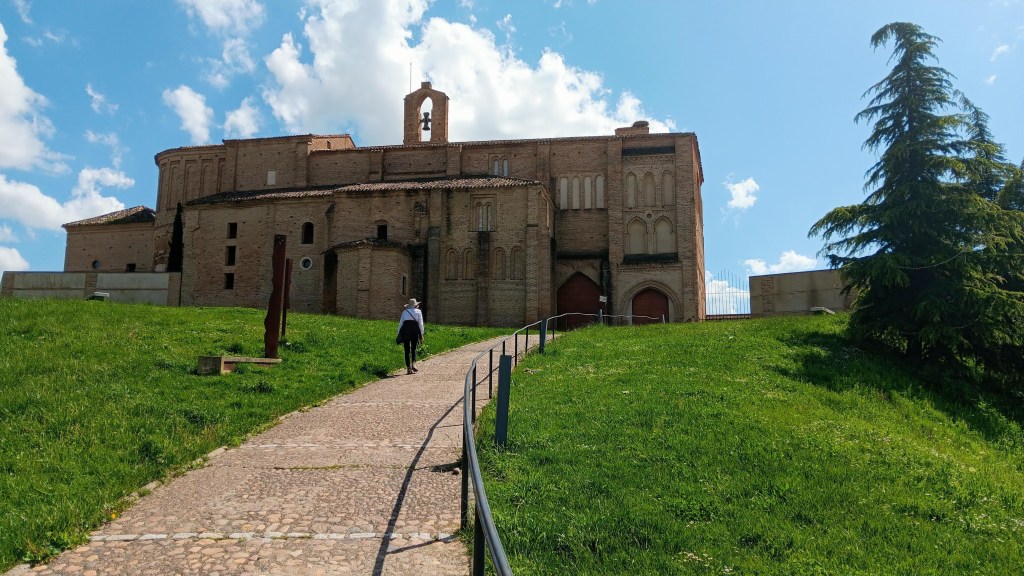
In Carrión, there are at least two monasteries. There is the Monasterio de Santa Clara – which I think is still a working monastery. The municipal albergue is located there. Through the public entrance to the courtyard, there is a Pilgrims Well. Tradition says that the well is the middle point of the Camino Francés. There is also a museum in the Monastery.
My group stayed at the Monasterio de San Zoilo. A very nice hotel is located in part of the monastery. The building for the original monastery, however, is still standing. Today, it contains a museum and a chapel that holds relics from San Zoilo – a 4th century martyr. Also worth a visit is the Iglesia de Santa María del Camino.
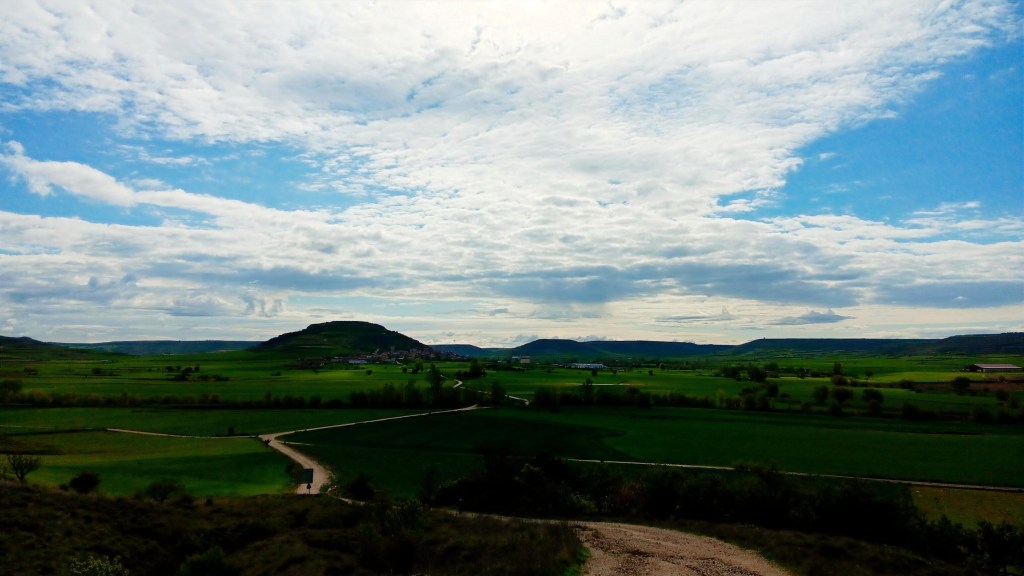
The walk between Boadilla and Carrión de los Condes is flat, with very little shade. It is a typical Meseta walk – very flat and long stretches between stops. It is a good opportunity to walk as a meditation – focusing on your feet and letting your mind be open to the presence of God
Carrión de los Condes to Sahagún.
After Carrión, we continued to Sahagún. We walked this stage in two days. The first day we walked to Calzadilla de la Cueza. Another very flat day with long stretches between stops. The only stop during the day is described as a “seasonal café.” There is no running water, and there is no bathroom – but it is a great stop. Everyone is there – it is a great place to enjoy a rest and the company of other walkers. I had fresh squeezed orange juice and a croissant. It was one of my favorite stops on the Meseta.
The next stop was our stop for the night – Calzadilla de la Cueza. The place where we spent the night was comfortable and welcoming – with good food in their restaurant.
The next day we walked to Sahagún. It was a similar walk to the day before. Although, as we got closer to Sahagún, we saw more walkers and more people who lived in the nearby towns. A little before we entered Sahagún, the path took us past the Ermita Virgen del Puente. On the day we walked, the parishioners were celebrating a festival. We stopped for an ice cream and watched their procession into the Church.
In Sahagún, we visited the Monasterio de la Virgen Peregrina, where we received certificates documenting that we had completed the first half of the Camino Francés.
Listening with the Ear of Your Heart.
I felt the influence of monastic communities on this part of the Camino. There is a strong presence of France’s Cluny Abby. During the Middle Ages, Cluny established a network of monastic communities that were independent of the nobility. They began as Benedictine communities. Later, they led the Cistercian reform of Benedictine monasticism. Most of the monasteries are now ruins. However, the feeling of Benedictine spirituality runs strong in this part of Spain.
Benedictine spirituality is a pilgrimage of the soul. The Rule of St. Benedict begins by instructing us to listen with “the ear of our heart.”1 When we focus “the ear of our heart” on how we live our lives, we engage in what the Benedictines call “Lectio on Life.”2
I meet many people walking the Camino in pilgrimage. They are looking to bring God into the empty places of their lives. Their heart’s desire contains hopes of healing – of letting go of the things that keep them from feeling “at home,” within themselves.3 The Camino gives us time to create the space for God to become present in our empty places – it is a long walk filled with quiet space. Using “Lectio on Life” on the Camino is a way to walk in pilgrimage and experience the healing and “letting go” that we are searching for.
The first step of “Lectio on Life” is “Lectio.” “Lectio” is walking mindfully, letting our lived experiences gently drift through our thoughts as we walk. Walking mindfully allows us to create space in our thoughts for God to be present. If we are gentle with the process, we find that God will focus our thoughts on the things we need to work on. “Lectio” is noticing the places in our lives where we are asking God to be present.
The second step is “Meditatio.” As we continue our walk along the Camino, we meditate on those places where we ask God to be present. It should feel like a prayer where we give our attention to God, taking the time to listen for God’s voice. It is a different type of “listening.” We hear with our hearts so we can feel God communicating His/Her self to us. “Meditatio” is meditating on the empty places and listening with the “ear of our hearts” to God’s communication in those places.
The third and fourth steps are “Oratio,” and “Contemplatio.” In “Oratio,” we offer up a prayer for God’s assistance as we continue to work through the empty places of our lives. The prayer can be a scripture passage, a sermon, or something from the monastic tradition – like the Rule of St. Benedict. Focusing on our words of prayer allows us to shift our attention away from ourselves. We wait in silence waiting for God’s presence. “Contemplatio” is this process of contemplation. Contemplation creates the space within our hearts for God to communicate His/Her presence. There is a lot of time for contemplation on the Camino.
The final step is “Operatio.” As we let God work on our hearts, we see how God meets us in each moment. We decide what steps to take to move forward with God. We decide how we want to reflect God within our lives. We decide how we want to reflect God into the world.
I have read that the best view on the Meseta is the view of the sky. On sunny days, the sky is a beautiful blue and the clouds are fluffy and white. Walking on rainy days, the rays of sunshine peak out from the clouds, reaching the ground in a stream of light. Taking the time to experience the beauty of the walk, you will find all the places where God is present on your path. And you will find all the places where God is present in your life.
- Rule of St. Benedict, Prol. 1-2. ↩︎
- Based on “Lectio on Life,” by Luke Dysinger, OSB. Viewed on 7-22-2026 at CSBSJU Website (Dysinger, OSB) ↩︎
- See Esther de Waal, A Life-Giving Way: A Commentary on the Rule of St. Benedict (Collegeville, MN: Liturgical Press, 1995) 7. ↩︎



Leave a Reply