Stage 13 – Atapuerca to Burgos.
The Walk.
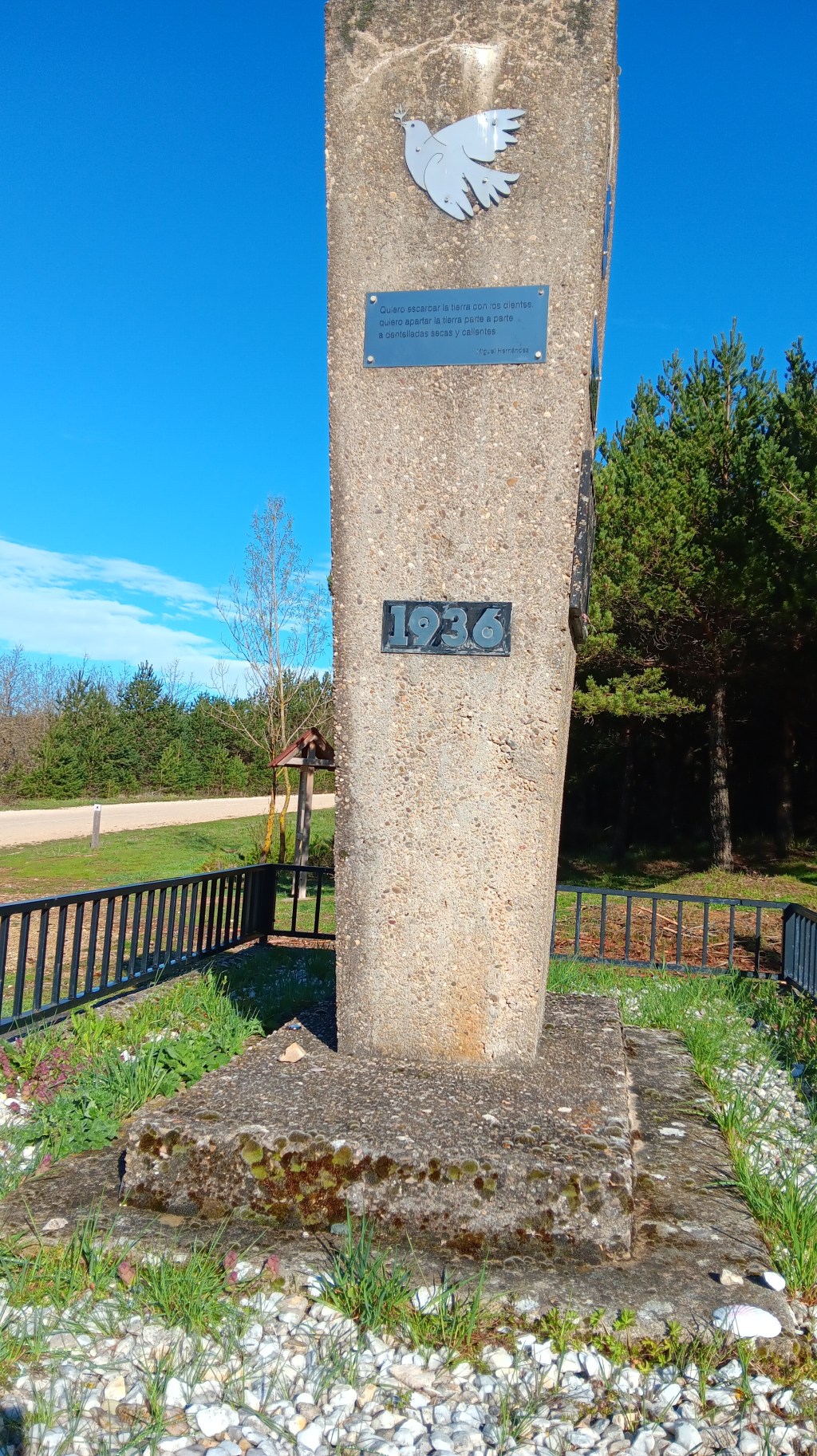
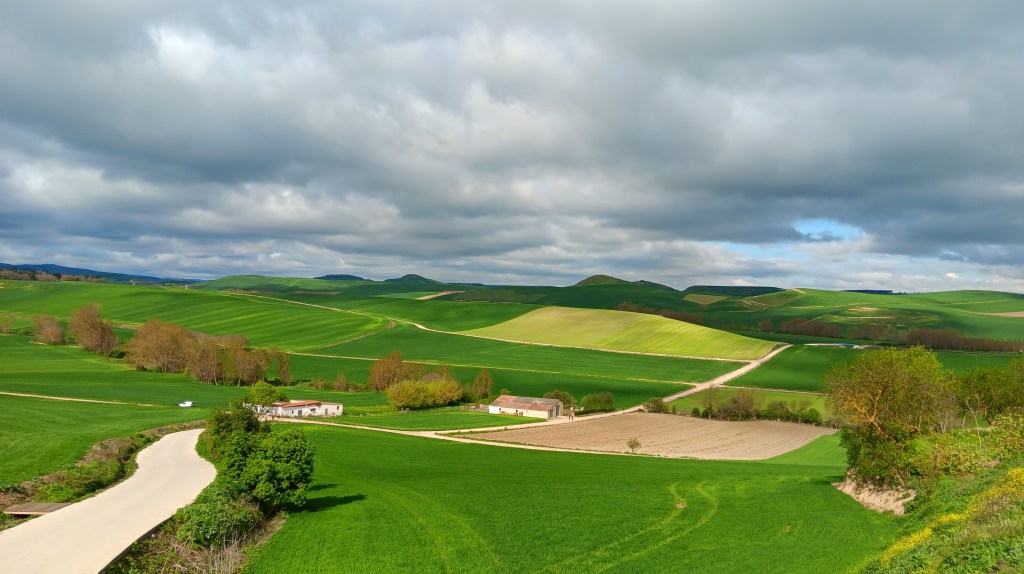
What I remember from this part of the Camino was climbing from Atapuerca to the top of a hill. The trail went through a pine forest. At the top of the hill, I looked out over the Meseta of central Spain. The view is expansive – it feels like you can see the whole world from that one place.
The walk across the Meseta is the most contemplative part of the Camino. The path is flat and there are long distances between towns. You have to focus your attention on your feet – both the steps you are taking and the uneven ground. If your attention is anywhere else, you risk tripping on a random rock and falling on your face. The unexpected benefit of focusing on your feet is that it quiets your thoughts. It is within these quiet spaces that God fills us with His presence.
I loved the view from the top of the hill. I felt like I could see all of Spain. I could have stayed all day. But I took one more look at the Meseta and pressed on to Burgos. It was Good Friday and I wanted to be at the Catedral for the community’s Good Friday procession.
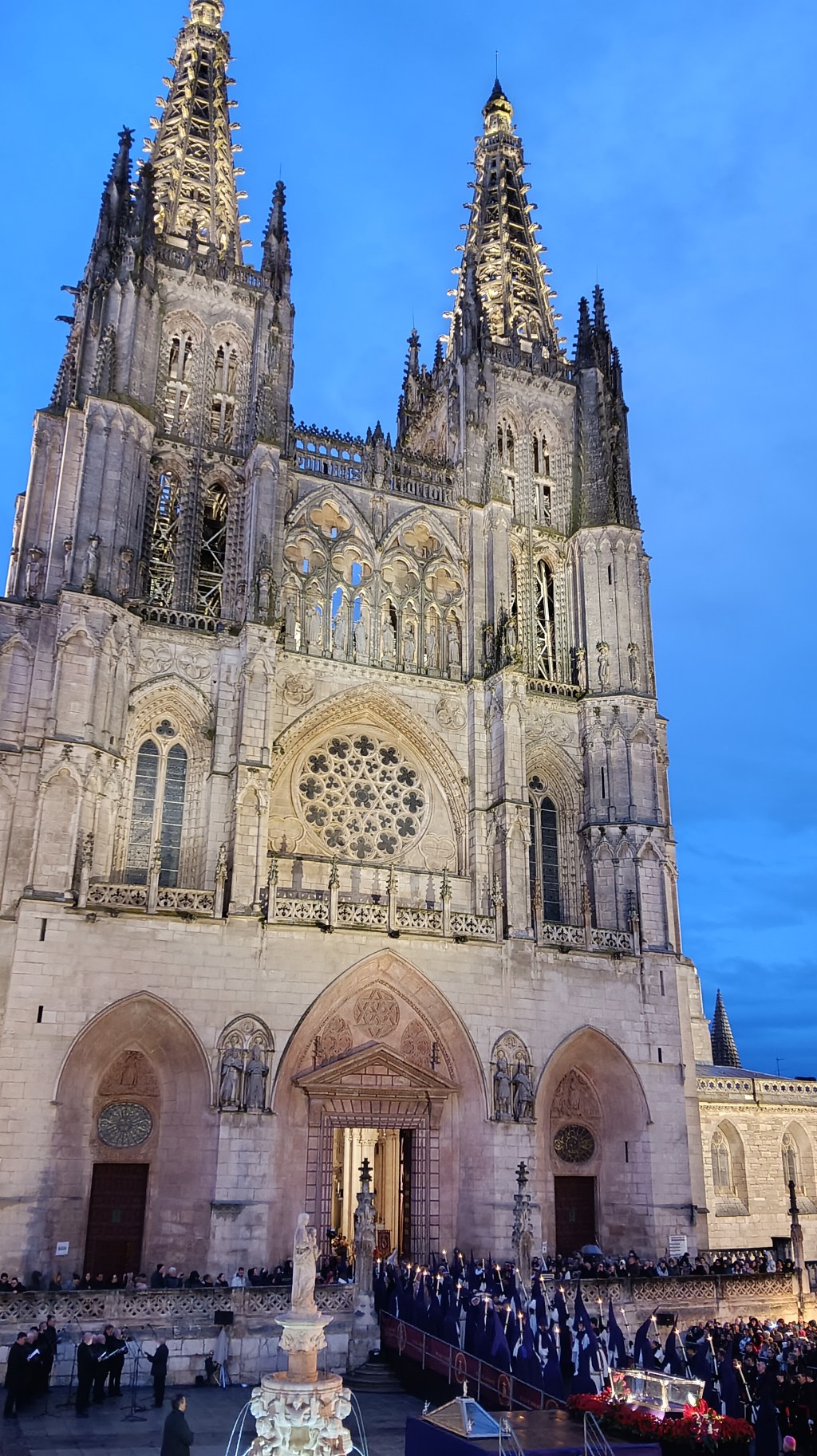
The Catedral of Burgos (la Catedral de Santa María de Burgos) is a beautiful Gothic cathedral dedicated to Mary. Because construction started in the 13th century and it took 300 years to build, it represents a complete history of Gothic art during the Middle Ages. It is a World Heritage site.
The Good Friday procession from the Catedral begins with the Church taking Jesus down from the cross. They carry his body outside the Catedral to be placed in a glass coffin. Every parish in Burgos has their own float for the procession. We see Jesus praying in the garden of Gethsemane. Jesus being nailed on the cross. Jesus dying on the cross. We see many floats of Mary. There are bands. Parishioners walking behind their floats. It is a community remembrance of Christ’s Passion. For me, the remembrance of Good Friday at the Catedral is an opportunity to center the spirituality we encounter on Camino in the mission of Jesus and the reality of the Cross
Good Friday at the Catedral de Santa María de Burgos
Good Friday is a day to deepen our spirituality by contemplating the meaning of the Cross. If you remember, we began our Camino walking through the beech forests of Roncesvalles. We experienced the presence of God in the trees of the forest. We felt how the trees were grounded in the earth and nourished by the rain. We imagined God as being the earth for us and remember the times that we were the earth for others.
On Good Friday, we anchor our experience of God in the person of Jesus Christ. Preaching Jesus is always difficult because who Jesus is changes depending on who is telling the story. We must be mindful of the fact that those who try to tell us who Jesus is may not be speaking for Jesus. Those who use Jesus to support their power are telling us who they are. They are telling us what they want us to believe. Our pilgrimage is different. We are learning to experience God for ourselves, in the quiet of our hearts.
We see this in Matthew 16:13-17. Jesus first asked his disciples who the people said he was. The disciples replied: “John the Baptist, Elijah, Jeremiah or one of the prophets.” The people did not see Jesus. They saw what they wanted to see.1 But then Jesus asks his disciples, “But who do you say that I am?”2 Simon (Peter) searches his heart and replies: “You are the Messiah, the Son of the living God.”3 Jesus recognizes that Simon’s answer was revealed by God. “Blessed are you, Simon son of Jonah. For flesh and blood has not revealed this to you, but my heavenly Father.”4 Simon (Peter) emptied himself to let God fill his heart with the answer.
This part of our Camino walk, we learn to empty our own hearts. It creates space for God to reveal the answer to Jesus’ question: “But who do you think I am?5
When I contemplate “Who is Jesus,” I focus my thoughts on the earliest followers of Jesus. These are the people who most likely had a personal experience of Jesus or knew someone who did. It was also a time before people knew what to believe. For this reason, I find wisdom in the purity of their worship.
History knows what earliest followers of Jesus thought through the hymns they recited and sung. Paul’s Letter to the Philippians contains a part of one of those hymns. The hymn is thought to have been recited within the first 20 years after Jesus’ death.6 It tells us that Jesus was in the form of God. But he did not grasp for divinity. He did not grasp for power. Instead, Jesus became human and was obedient to God to the point of his death.7 For this, God greatly exalted Jesus, and gave him a name above every name.8
[Christ Jesus]
Who, though he was in the form of God,
Did not regard equality with God something to be grasped.

Rather, he emptied himself,
taking the form of a slave,
coming in human likeness;
and found human in appearance,
he humbled himself,
becoming obedient to death,
even death on a cross.

Because of this, God greatly exalted him
and bestowed on him the name
that is above every name,
that at the name of Jesus
every knee should bend,
of those in heaven and on earth and under the earth,
and every tongue confess that
Jesus Christ is Lord,
to the glory of God the Father.
N.T. Wright, who is a theologian and religious historian, explains that this hymn shows a strong belief in the Resurrection. It further shows their belief that the Resurrection vindicated Jesus as the Messiah and son of God. These beliefs suggest that the early followers of Jesus felt the presence of Jesus in a personal and powerful way. And this feeling occurred after his death, resurrection, and ascension into heaven.9
My goal for the Camino walks over the next few days is to create space for the presence of Jesus. To experience that presence in the same personal and powerful way as experienced by his early followers. We do this the same way we emptied our hearts and minds to experience the beech forest of Roncesvalles. But instead of the forest, we focus on the experience of Good Friday in Burgos. We focus on the lifeless body of Jesus being placed in the glass coffin at the beginning of the Procession. We contemplate the meaning of Jesus. Specifically, his solidarity with those without power, those who are suffering, and those who are marginalized by our society. Only then do we ask, “who does Jesus say that he is?”
As we walk, we allow ourselves to be open to encountering a new experience of Jesus.
[1] N.T. Wright, Paul and the Faithfulness of God, Book II, Parts III and IV (Minneapolis, Minnesota: Fortress Press, 2013) 690.
- Matthew 16:14. ↩︎
- Matthew 16:15. ↩︎
- Matthew 16:16. ↩︎
- Matthew 16:17. ↩︎
- Matthew 16:15. ↩︎
- Philippians 2:6-11; Pheme Perkins, “The Letter to the Philippians,” in The Jerome Biblical Commentary for the Twenty-First Century (3rd ed., ed. John J. Collins, Gina Hens-Piazza, Barbara Reid OP, and Donald Senior CP; New York, NY: Bloomsbury Publishing Plc, 2022) 1697. ↩︎
- Philippians 2:6-8. ↩︎
- Philippians 2:9-11. ↩︎
- N.T. Wright, Paul and the Faithfulness of God, Book II, Parts III and IV (Minneapolis, Minnesota: Fortress Press, 2013) 690. ↩︎
 Pilgrimage: A Journey of Transformation
Leave a comment