Stage 12- Belorado to Atapuerca.
The Walk.
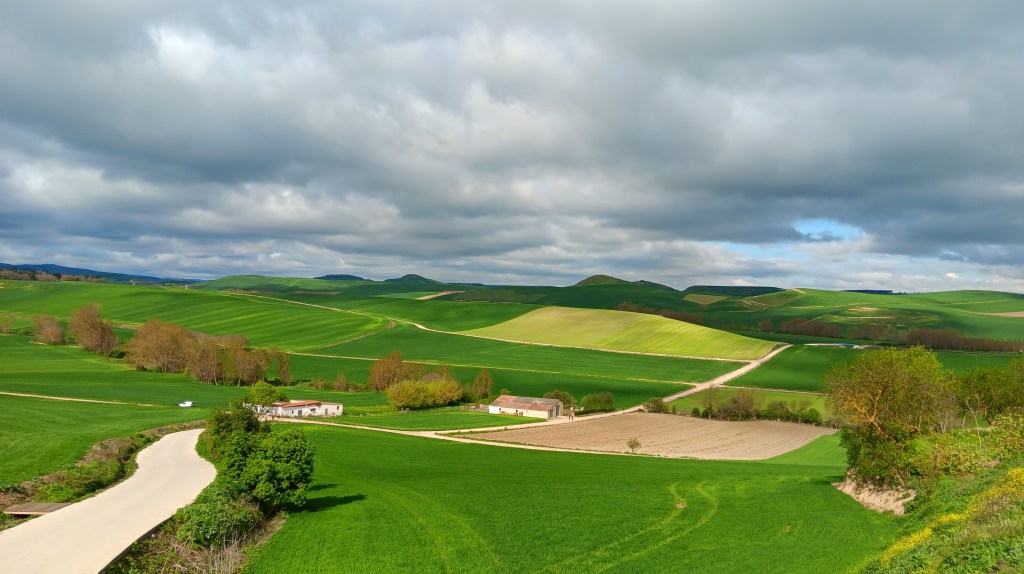
This part of the Camino is filled with open spaces. There are not a lot of places to stop. During the day we carried snacks for the trail. At night we slept in small villages.
Because of the lack of large towns, everyone seems to decide where they stop and how far they walk differently during this part of the Camino. Our group walked Stage 12 in 2 days. The first night we stopped in Villafranca Montes de Oca. It is a small village. What I remember from that day is having a wonderful Sopa de Ajo at the Hotel Abad for lunch. It was warm and hydrating – and they put a fried egg in it.
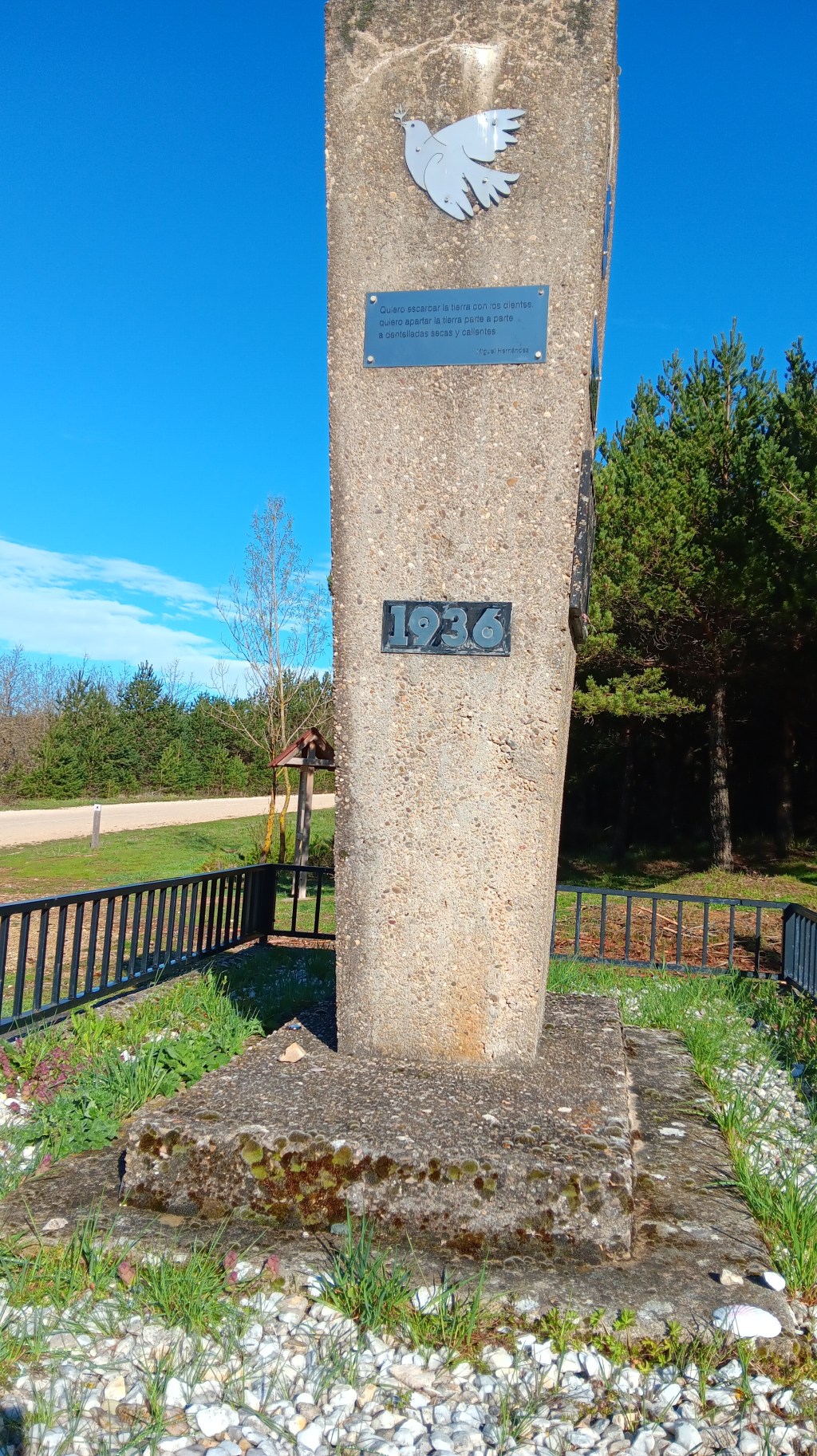
The second day, we walked to Atapuerca. Leaving Villafranca Montes de Oca, our walk took us uphill through the woods towards San Juan de Ortega. Towards the top of the hill, there is a monument to those who were “disappeared” in the first few months of the Spanish Civil War – El Monumento a los Caídos. The monument marks the grave where 300 hundred bodies were found. It would be a misunderstanding of the lessons of history to believe that this monument is only a memorial to atrocities that happened almost 100 years ago. We live in a world where our sins are still reflected in the deaths of innocent people.
In the face of the cruelty of our age, I am only comforted by the fact that God sees. I believe in God’s justice and mercy.
Atapuerca is a small village. There is one main bar where you can get lunch or dinner. We had a typical pilgrim dinner – ensalada mixta, pan fried chicken with french fries and red bell pepper. We also caught the day’s last tour bus to see the archaeological dig in the surrounding hills. It is one of the most significant archaeological finds in Europe – a World Heritage Site. You can find many of its artifacts in the Museum of Human Evolution in Burgos.
Creating a Contrite Heart.
I am always uncomfortable talking about sin. The reason is that those who create evil in our world are too arrogant to see their sins. They do not see the damage they cause. And those who suffer their evil are made to feel less worthy by society yelling “sin” at them.
True happiness comes from feeling at home with ourselves and within our community. That feeling only happens when our hearts are humble; when we see the places where our actions hinder God. The book of Jeremiah tells us that God has written His law on our hearts.1 Meaningful repentance only happens if we embrace the new heart that God has placed within us.2
“Repentance” is a state of humility, where we learn to listen to God with the ear of our hearts.3 A humble contrite heart learns to align its will with the will of God.
*******
Walking towards Burgos, we focus on creating a humble heart to prepare for the remembrance of Good Friday. I chose Psalm 51 as my prayer for the day. Psalm 51 tells us that sin is between God and ourselves – no one else. Through that prayer, we ask for God’s help to turn our hearts to Him. We understand that the trouble we face is in us – within our own hearts.4
For I know my transgressions,
   and my sin is ever before me.
Against you, you alone, have I sinned,
   and done what is evil in your sight.5
The most important part of repentance, however, is accepting the gift of God’s grace. Praying Psalm 51, we are anchored by our belief in God’s grace.
Have mercy on me, O God,
   according to your steadfast love;
according to your abundant mercy
   blot out my transgressions.
Wash me thoroughly from my iniquity,
   And cleanse me from my sin.6
Our acknowledgment of sin is not an act of self-immolation in the face of other people’s criticisms. It is a statement that we know our own character. We accept the strength of God’s mercy. And we use that strength to align our core values with the values of God – values of humility, mercy, and justice.7 By making this choice, we are renewed.
Create in me a clean heart, O God,
	   and put a new and right spirit within me.
	Do not cast me away from your presence,
	    and do not take your holy spirit from me.
	Restore to me the joy of your salvation,
	  and sustain in me a willing spirit.8

O Lord, open my lips,
	   and my mouth will declare your praise.
	For you have no delight in sacrifice;
	   if I were to give a burnt offering, you
		would not be pleased.
	The sacrifice acceptable to God is a broken spirit;
	   A broken and contrite heart, O God, you will not despise.9
The Book of Jeremiah teaches that God has offered us a new covenant. A covenant where God’s law is written on our hearts.10 We cannot know that law, however, unless we humble our hearts so that we hear the will of God. A contrite heart allows us to stop pretending that we are doing God’s will. Instead, we learn to humbly listen for God’s self-communication to us. We learn to place God’s will above our own.
True faith is not an expression of power, but one of humility. Only when we accept that humility, will we feel renewed.
On this day’s walk, as I prepared for Good Friday and Easter Sunday, I prayed Psalm 51. I asked for a humble contrite heart in the hope of receiving God’s renewal.
- Jeremiah 31:33. “I will place my law within them, and write it upon their hearts; I will be their God, and they shall be my people.” ↩︎
- Ezekiel 36:26. “I will give you a new heart, and a new spirit I will put within you. I will remove the heart of stone from your flesh and give you a heart of flesh.” ↩︎
- Rule of Saint Benedict, Prologue ¶ 1. ↩︎
- James L. Mays, “Psalms,” in Interpretation: A Bible Commentary for Teaching and Preaching (Westminster John Knox Press: Louisville, 2011), 198. ↩︎
- Psalm 51:3-4 (NRSV). ↩︎
- Psalm 51:1-2 (NRSV). ↩︎
- See Isaiah 1:12-17, Micah 6:8. ↩︎
- Psalm 51:10-12 (NRSV). ↩︎
- Psalm 51:15-17 (NRSV). ↩︎
- Jeremiah 31:33. ↩︎
 Pilgrimage: A Journey of Transformation
Leave a comment