Stage 11 – Santo Domingo de la Calzada to Belorado.
The Walk.
Yesterday and today were long walks. Nájera to Santo Domingo, and Santo Domingo to Belorado were about 15 miles (24 km) each. Both days were close to my walking limit. Also, there were not many places to stop during this part of the Camino. And the walking weather was a little rainy because we were walking at the beginning of April.
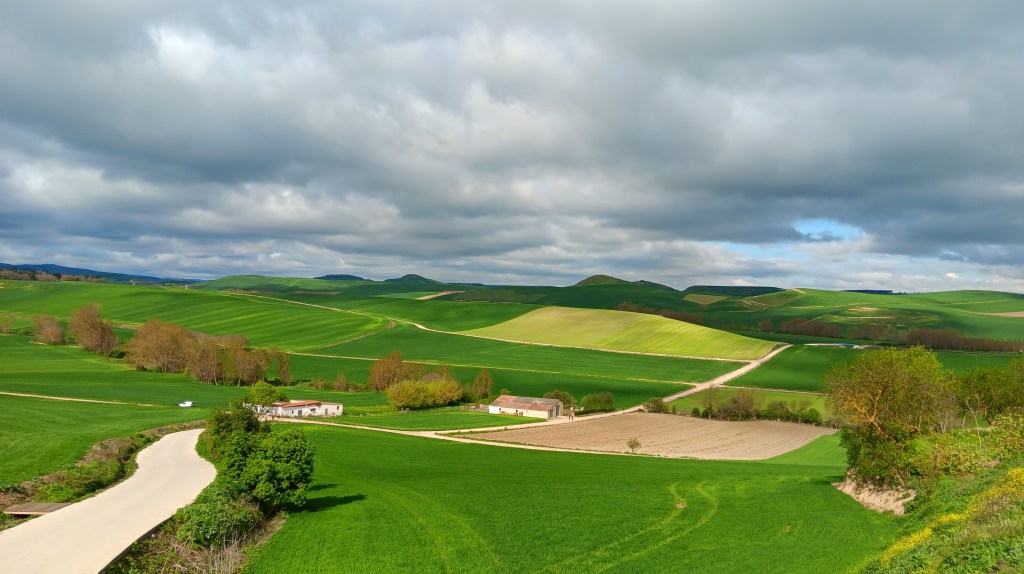
But the views on this part of the Camino are beautiful and expansive. You can see for miles. It is also interesting to see how the landscape begins to change. Walking from Nájera to Santo Domingo, the vineyards start to change to field crops. At first, you see random fields of yellow flowers. Then the landscape is dominated by the fields of yellow flowers. The flowers are rapeseed – they produce canola oil.
By the time we leave Santo Domingo, we have left the vineyards behind. We still see the beautiful fields of yellow flowers. But the main crops during this part of our walk are wheat and barley. For miles and miles, you see fields of wheat. This time of year – April – they are green and move in the gentle breeze.
This part of the walk can feel a little lonely. There are not a lot of towns. But if you let yourself enjoy the solitude and the beauty of the fields, you create quiet within your mind. During my walk, I let the quiet fill me with a spirit of contemplation. Through that spirit, I changed the focus of my thoughts from my concerns to looking for the face of God. I look for glimpses of God in nature, art, bible stories, or other expressions of God’s presence. On this day, I listened for God’s voice in the quiet.
The Kingdom of God is like . . .
On the Camino, I love walking through vineyards and fields. It transports my mind to ancient Judah. Much of the imagery of the Bible connects us to a simple world deeply connected to growing things.
Vineyards remind me of the disaster suffered by the people during the time of the exile to Babylon. At that time, the people connected the destruction of their community to its lack of justice and mercy.
For the vineyard of the Lord of hosts
is the house of Israel,
and the people of Judah
are his pleasant planting;
he expected justice,
but saw bloodshed;
righteousness, but heard a cry!1
Bringing ourselves into the story, the community is destroyed by its failure to care for the least of its members. A community that only works for the powerful is not a community of God. It is not the vineyard that God planted.
By the time of Jesus, the people of Judah had been allowed to leave Babylon. But they were still in a state of exile. They were waiting for God’s reign to return to Jerusalem.
Listen! Your sentinels lift up their voices,
together they sing for joy;
for in plain sight they see
the return of the Lord to Zion. . . .
The Lord bared his holy arm
before the eyes of all the nations;
and all the ends of the earth shall see
the salvation of our God.2
The people took heart that scripture promised God’s return to Jerusalem. They waited for God to again dwell with his people and judge Israel’s enemies. Jesus’ entry into Jerusalem on Palm Sunday is seen as Jesus’ enacting this saving action of God’s return.3 We understand its meaning in connection with Jesus’ ministry of announcing the coming of the Kingdom of God.
Living in the vineyard planted by God requires us to reflect God’s values into our community. These values are centered on the meaning of God’s Kingdom. And although God’s Kingdom was made real through Jesus, is not yet the reality of our world. In God’s Kingdom, the oppressed are lifted and the hungry are made full. And although God scatters the proud, He shows mercy to those who see Him as their God.4
Yet, it is hard to hold on to the Kingdom when we do not always see it. In our world, the poor and oppressed are hungry, and not lifted. Watching their suffering, we ask: “where is God’s mercy?” As I think about this walking through the wheat fields, my thoughts wander to Jesus’ images of the Kingdom.
“The kingdom of God is as if someone would scatter seed on the ground, and would sleep and rise night and day, and the seed would sprout and grow, he does not know how.”5
Walking with the parable, we experience the growing wheat. It is a mystery – its growing is barely perceptible as we walk by. But walking over time, we can see the wheat change and become ready for the harvest. Like the wheat, creating community where God is present requires a long faith. We may not see God’s justice and mercy in a world dominated by the powerful. But we continue to reflect God into the world. We hold on to our faith that God’s Kingdom will grow – although we may not always understand how.
- Isaiah 5:7 (NRSV). ↩︎
- Isaiah 52:8,10 (NRSV); N.T. Wright and Michael F Bird, The New Testament in Its World: An Introduction to the History, Literature, and Theology of the First Christians (London, Great Britain: Society for Promoting Christian Knowledge 2019), 235. ↩︎
- Wright and Bird, The New Testament in Its World, 235. ↩︎
- Luke 1:49-53. ↩︎
- Mark 4:26-27 (NRSV). ↩︎
 Pilgrimage: A Journey of Transformation
Leave a comment