A Reflection on Forgiveness.
Pamplona to Uterga.
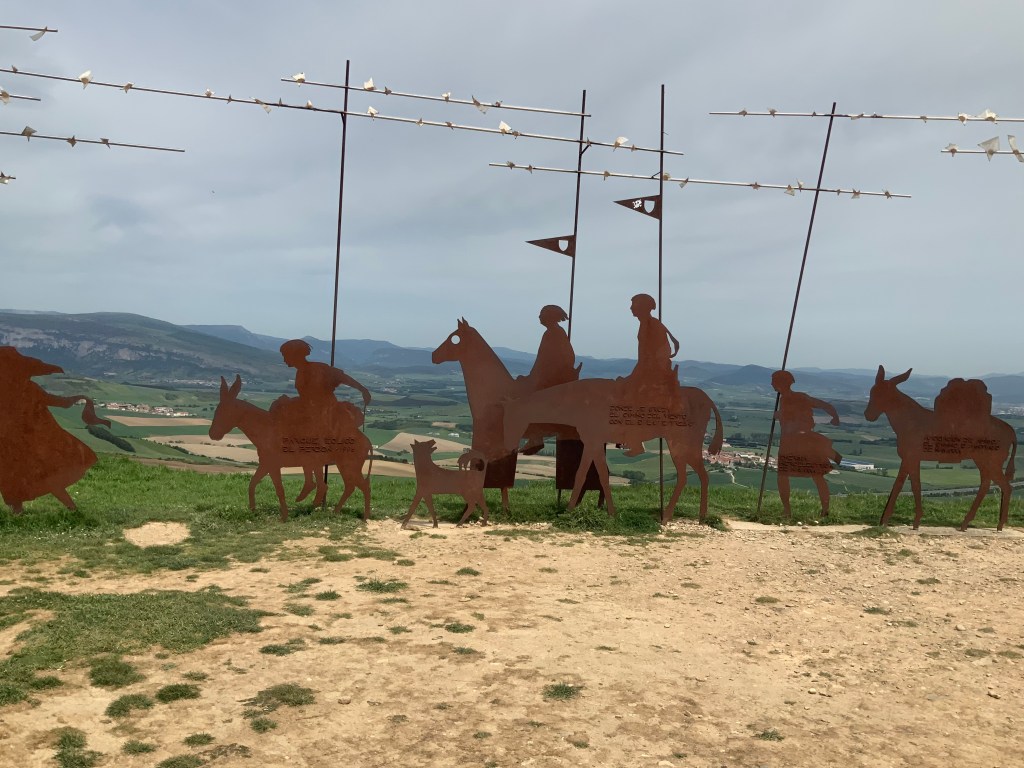
Alto de Perdón, loosely translated means “the mountain of forgiveness.” The mythology of the trail is that if a pilgrim climbs the Alto de Perdón, his/her sins will be forgiven. If the pilgrim then dies before arriving in Santiago, the pilgrim is welcomed into paradise. It is a nice thought that all we have to do to experience forgiveness is climb a little hill in Spain.
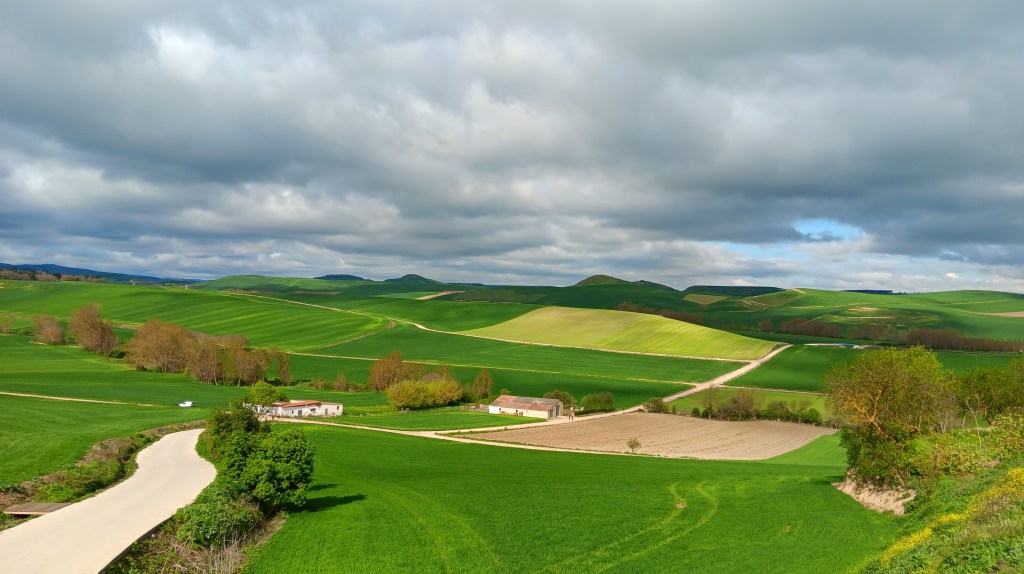
I began the day’s walk contemplating forgiveness. I left an hour later than the other pilgrims, so I had the trail to myself – so much so that I was afraid I took a wrong turn leaving Pamplona. But no, I was just a slow walker and the coffee in Spain is so good it was worth a second cup! Whatever the circumstances, I walked alone with my thoughts.
I didn’t think about God’s forgiveness on the way up the hill. Instead, I thought about the stories our little group told at dinner the night before. The stories of the times we had been hurt by the actions of other people. As I walked up the hill, I thought of all my past hurts and how complicated forgiveness was.
People are entitled to their feelings. I would not want the concept of “forgiveness” to cause someone to feel victimized a second time – whether emotionally, economically, or spiritually. It seemed to me that our feelings of hurt, anger, sadness, and outrage should be managed separately from “forgiveness.” If we can use the arrow prayer of the Desert Elders to acknowledge our feelings without being controlled by them, we might find a healthy way to protect ourselves from those hurts – and maybe also a path forward towards justice.1
Managing our feelings, however, is not the same as “forgiveness.” I just know from my own life that being gracious to others and responding to them with mercy is different than trying to forgive by healing the hurts of the past. So, as I walked up the mountain of God’s forgiveness, I asked: “how do we forgive the way God wants us to forgive, and still honor our need to heal our own hearts?”2
When I read the books of the Prophets, I notice the strong feelings of God. I also notice God’s outrage at those who reject the path of humility, justice, and mercy. In the Book of Jeremiah, God expresses his outrage at the sins of his people:
“Peace, peace!” they say,
though there is no peace.
They are odious; they have done abominable things,
yet they are not at all ashamed,
they know not how to blush.
Hence they shall be among those who fall;
in their time of punishment they shall go down,
says the Lord.3
The other thing I notice when I read the Prophets is that no matter the outrage expressed by God, the final word in each story is the outpouring of God’s mercy. Even when we feel that we have lost everything and that we will never again experience God’s love, God remembers his promise of steadfast love and reaches out to us with mercy.
For thus says the Lord:
Incurable is your wound,
grievous your bruise;
There is none to plead your cause,
no remedy for your running sore,
no healing for you.
. . . .
Because of your great guilt,
your numerous sins,
I have done this to you.
Yet all who devour you shall be devoured,
all your enemies shall go into exile.
All who plunder you shall be plundered,
all who pillage you I will hand over to pillage.
For I will restore you to health;
of your wounds I will heal you, says the Lord.4
I love this passage from Jeremaiah because it reminds me of God’s intensity of feelings. It also reminds me that no matter how sideways my relationship with God might end up, God’s outreach to me is always based on mercy. For this reason, when I reflect on my obligation to forgive those who have wronged me, I remember that God’s forgiveness is expressed as mercy. I do not try to deny the hurt and betrayal that I feel. I just remember that I have an obligation to respond to my debtor with mercy.
The benefit of seeing forgiveness as an act of mercy is that your emotional energy is focused on the present and not wasted on re-living the hurts of the past. Although it is important to heal from those hurts, I find that giving myself the emotional space to heal is better than trying to pretend that the act of “forgiveness” will make that hurt go away. My way of creating this space is by using the arrow prayers of the Desert Elders to quiet my thoughts so that God’s spirit can break through.5
Camino Notes:
On the path hiking down from the Alto de Perdón, find a rock that you are comfortable walking with. Later along the Camino, we will arrive at the Cruz de Ferro. At the Cruz de Ferro, pilgrims are encouraged to leave a rock representing something in our lives that we want to let go of.
As part of our pilgrimage, I encourage you to use the rock taken from the Alto de Perdón- the place that represents God’s forgiveness of us – to carry to the Cruz de Ferro. As you walk along the Camino with that rock, use a favorite bible passage or prayer to short-circuit any negative emotions that arise when you think of the hurt that your rock represents. As those thoughts dissolve, see what God puts in their place. When you arrive at the Cruz de Ferro, leave the rock. As you put the rock at the foot of the cross, ask God to help you find the emotional and spiritual space you need to truly heal from that hurt.
We ended our walk for the day in Uterga – which I recommend. It gave us the time, on the next day, to take the longer route and visit a 13th century church – the Ermita de Santa Maria de Eunate.
- “And what the Lord requires of you: Only to do justice and to love kindness, and to walk modestly with your God?” (Micah 6:8) (emphasis added). ↩︎
- See Mathew 6:12 (NRSV). ↩︎
- Jeremiah 8:11-12 (NRSV). ↩︎
- Jeremiah 30: 12, 15 (NRSV). ↩︎
- See https://wanderingwithgod.com/2024/06/11/pilgrimage-on-the-camino-roncesvalles-to-zubiri/ ↩︎
 Pilgrimage: A Journey of Transformation
Leave a comment